A leak in a ceiling, a wall or a buried pipe is an emergency the moment water is moving where it should not. Our crews cover Palisades Park, NJ around the clock with 24/7 emergency dispatch. While you wait, shut the main water valve, switch off power to any wet area from the breaker panel, and move people and belongings away from the dripping spot.
Leak detection is the work of finding exactly where a pipe is losing water without tearing the house apart to look. We use listening gear, thermal cameras, pressure tests and moisture meters to narrow a leak down to a small patch of wall, floor or yard. Then the repair is a targeted fix instead of a demolition project.
Do you hear water running but cannot find it?
A faint hiss behind a wall, a warm patch on a floor, or a bill that jumped for no reason all point to the same thing: water is escaping somewhere you cannot see. People often search for a way to find a leak behind drywall or under concrete without cutting everything open. The professional name for that service is leak detection, and it is what this page covers.
The goal is simple. Find the pipe, confirm it is the source, and tell you the cheapest honest repair before any wall comes down.
Signs of a hidden leak
Small clues show up weeks before the damage does. Any one of these is worth a closer look.
A bill that keeps climbing
Usage creeps up with no change in household habits. A slow leak can run day and night for months.
Sound with nothing running
Hissing, dripping or a faint rushing noise when every faucet is closed and no appliance is on.
Stains and bubbling paint
Brown rings on a ceiling, peeling paint or drywall that feels soft and cool to the touch.
Musty smell
A damp odor in a closet, cabinet or basement corner often means moisture is feeding mold nearby.
Warm floor spots
A patch of floor that stays warm can mean a leaking hot line running through or under it.
Weak water pressure
A sudden drop at every fixture can mean a break on the supply side before the water reaches the house.
Need a plumber now?
Call the 24/7 line and describe the problem. We book the next available appointment.
Water meter still moving with everything off
Your water meter is the cheapest leak detector you own. If it keeps registering flow while every tap, toilet and appliance is off, water is going somewhere. Many meters have a small low-flow dial or triangle that spins even at a trickle.
Check it before you call, and tell us what you saw. That one observation tells us whether to start inside the house or out at the service line.
Ceiling, wall and attic leaks
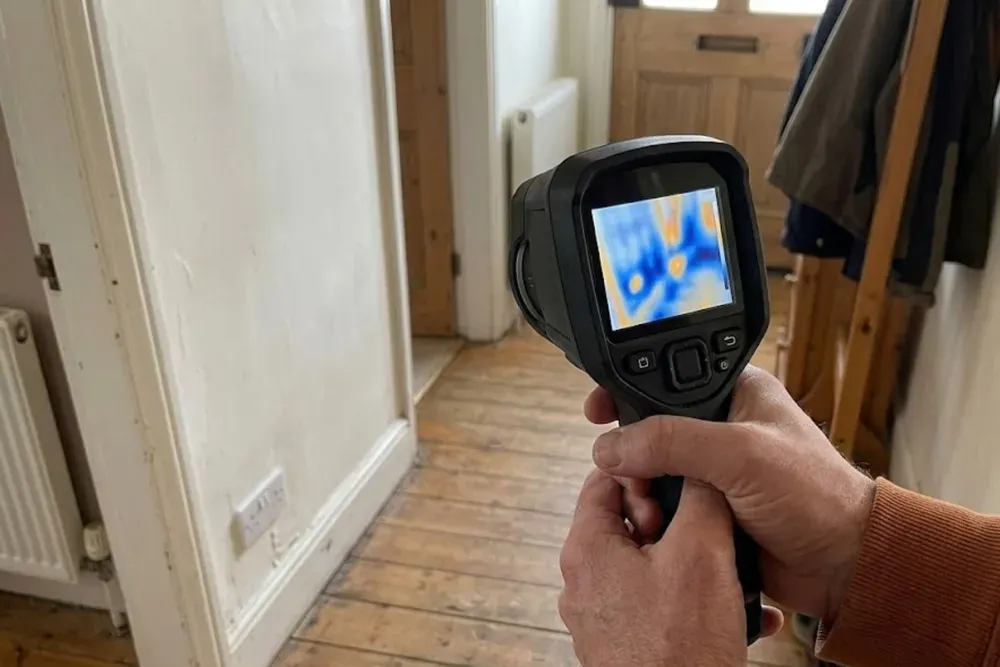
Water travels. A stain on a ceiling is rarely directly under the pipe that caused it, because moisture runs along joists and pipes before it shows. A thermal camera highlights cool, wet areas inside a wall, and a moisture meter confirms how far the dampness spreads.
In an apartment building the source may be a bathroom above you, a riser in a shared wall or a roof penetration. We trace the wet path back toward the source and mark it so the opening in your drywall is the size of a hand, not a doorway.
Under the house, in the basement or the crawlspace
If your home has a basement or crawlspace, the exposed pipes and drain lines overhead are the first place to look. Drips on a joist, a rusted hanger or a pipe sweating heavily may not be the same problem, and we sort out which is which. Condensation on a cold supply line is common and harmless. A pinhole spray is not.
When walls or floors cover the pipes, we switch to acoustic listening and pressure testing to find the leak from the outside.
Buried lines and slab leaks
A leak in the water line between the street and the house is hard to spot because the water soaks into soil. Wet ground, a soft patch of lawn, or a meter that spins with the house shut off all raise suspicion. Pressure drops across the line help confirm it, and listening gear pinpoints the spot along the run.
A slab leak is a break in a pipe under or inside a concrete floor. Warm spots, the sound of running water and sudden bill spikes are the usual signs. We locate it first, then talk through whether to reroute the line or open the slab.
For the repair side of a service line, see water service line repair.
The tools we use to find the leak
Different leaks call for different equipment. Most jobs use two or three of these together to confirm the answer.
| Method | What it does | Best for |
|---|---|---|
| Acoustic listening | Picks up the sound of water escaping under pressure | Buried lines, slab pipes, walls |
| Thermal imaging | Shows temperature differences from moisture or hot lines | Ceilings, walls, radiant or hot-line leaks |
| Moisture meter | Measures how wet a surface is and how far it spreads | Drywall, subfloors, cabinets |
| Pressure test | Isolates a pipe section and watches for a pressure drop | Confirming a leak exists in a run |
| Tracer gas | Safe gas injected into a line escapes where the leak is | Hard-to-hear leaks and deep lines |
No single tool is perfect. We cross-check before we mark a spot, because drilling in the wrong place costs you money.
Irrigation, pool and meter-box leaks
Lawn sprinkler systems leak at heads, valves and buried lines, and the first sign is often a soggy zone or a pump that never shuts off. If your property has a pool or spa, a falling water level that outpaces evaporation is worth a check. Those only matter if you own them, and we say so plainly if they are outside what we can do on a given visit.
The meter box near the curb can also hide a drip at a fitting. Your water utility may handle some of what sits in that box, so ask Veolia where its responsibility ends and yours begins.
Leaks in shops and commercial buildings
Restaurants and retail units along the Broad Avenue and Bergen Boulevard corridor run many fixtures every day, so a slow leak can hide behind busy equipment. We use the same listening, thermal and pressure methods in commercial spaces. Large or complex systems may need a longer visit, and we will tell you what we can and cannot cover before work begins.
Property managers can see our approach to larger buildings on the commercial plumbing page.
When a leak is an emergency
Most small drips can wait for the next available appointment. Active flooding cannot. Here is what to do first.
- 1
Shut the main valve
Turn it clockwise until it stops. Know where it is before you need it, usually near the meter or where the line enters the house.
- 2
Cut power near water
If water is near outlets, appliances or the panel, do not step into it. Switch off the breaker only if you can reach it dry.
- 3
Open a low faucet
With the main closed, open the lowest tap to drain the remaining pressure in the line.
- 4
Move valuables and take photos
Photos help with insurance, and lifting items off wet floors prevents ruined belongings.
- 5
Call the 24/7 line
Describe what you see and hear. We schedule after-hours and same-day visits when available, and we will tell you what to do while we come.
Fixing it once we find it
Finding a leak is only half the job. Repair options depend on the pipe material, its age and how many other weak spots show on the same run. A short spot repair is cheaper now, while a section replacement may make sense if the pipe is worn throughout.
If one failure suggests the whole line is tired, we explain when repiping is worth considering and when it is not. A burst or cracked section is handled as burst pipe repair. We cannot name your exact cost before seeing the job, but you will hear the price before we start work.
Why local conditions matter
Palisades Park water comes from Veolia's Hackensack system, and the 2025 water quality report lists hardness at 210 ppm, which is very hard. Hard water leaves scale on faucet fittings, valve seats and water heaters, and scale buildup can turn into a slow drip at a worn seal. The same report lists the water as non corrosive, so a leak is more often age, vibration or a failed fitting than the water itself.
If you live in nearby Fort Lee or Ridgefield, the same Veolia system serves you, and the same scale habits apply.
What affects the price
No two leaks cost the same, because the search and the repair depend on the building and the pipe. These are the real drivers.
Where the leak is
A visible pipe in a basement is quick to confirm. A line inside a wall, under a slab or underground takes more tools and time.
How many methods we need
Some leaks reveal themselves to one test. Others need listening, thermal imaging and pressure testing to be sure.
Access and opening size
Reaching a pipe behind tile, cabinets or concrete adds labor, and patching finishes afterward is a separate step.
Pipe material and condition
Copper, galvanized steel and plastic fail differently. Worn pipe may call for a longer section replaced.
Timing
After-hours and weekend emergency visits are priced differently from a scheduled daytime appointment.
Homeowners insurance may cover resulting water damage in some cases, but policies differ, so read yours or ask your agent. Want your real number? Call the 24/7 line.
Common Questions
Yes. Our 24/7 line is staffed for active leaks, including nights and weekends. Shut the main valve, keep people away from wet electrical areas, and call. We book same-day or after-hours visits when available and will not promise a specific arrival time over the phone.
We combine listening gear, thermal imaging, moisture readings and pressure tests. Each narrows the location, and we compare results before marking a spot. Often only a small patch needs opening, and we tell you before any cutting.
Check your meter with everything off. If it still moves, call us and describe what you saw. A running meter points to a leak somewhere between the meter and your fixtures.
Usually, yes. Slab leaks are located with acoustic listening and thermal clues before any concrete is cut. We then discuss rerouting the line versus opening the slab, since both have trade-offs in cost and disruption.
It can for the plumbing side, such as buried supply lines and valves. Pool shells, pumps and specialty sprinkler heads may need a specialist. We tell you honestly during the call what we can handle.
Yes. We give you a clear price before work starts. What we cannot do is quote an exact cost before seeing the job, since access, depth and pipe material change the work.
Report the leak to your landlord or property manager first, since they usually control repairs and may need to authorize work. They can call our 24/7 line directly, and we coordinate access with whoever holds the keys.
Licensing and permits
Under New Jersey plumbing licensing standards, plumbing work is limited to licensed master plumbers, authorized plumbing contractors and their employees. You can check any plumber through the NJ Division of Consumer Affairs, State Board of Examiners of Master Plumbers. Palisades Park also publishes permit and inspection details on the borough website.