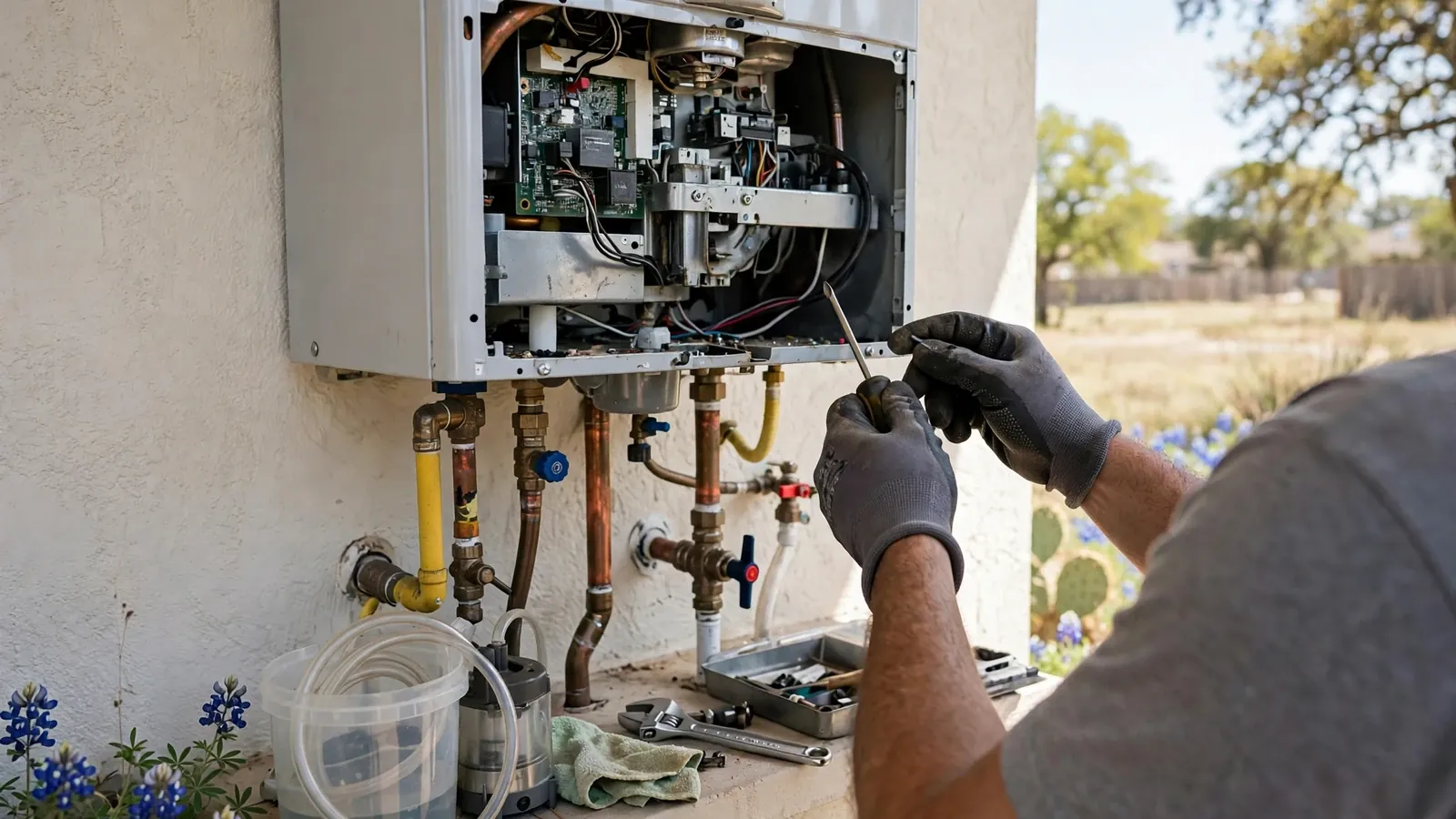
A tankless water heater heats water only when you open a tap, using a gas burner or electric elements and a heat exchanger instead of a storage tank. In Palisades Park, NJ it is a popular upgrade for homes short on space, and it needs care to keep delivering. We service, repair and install these units.
If your hot water runs out, fluctuates or shows an error code, the cause is usually fixable. Call the 24/7 line to book a visit.
Hot water that goes cold or cuts out mid-shower
That swing from hot to cold to hot again has a name: the cold-water sandwich. It happens when a tankless heater shuts off between short uses, and the pipe holds a slug of cold water before warm water arrives. Mineral scale inside the heat exchanger, a clogged inlet filter or a minimum flow rate that is not being met can cause the cut-outs too.
These symptoms point to a tankless water heater that needs flushing, adjusting or repair. The sections below cover each one.
Why 210 ppm hardness matters for a tankless unit
The Veolia Water New Jersey 2025 report lists hardness at 210 ppm as calcium carbonate, which it classes as very hard. A tankless unit heats water quickly through narrow passages, so mineral scale can narrow those passages and reduce flow and efficiency.
Scale is the main enemy of a tankless heater in Palisades Park. We do not give a lifespan number, since usage varies, but regular descaling is the best defense. A water softener may also help, and we can discuss that without making health claims about your water.
Need a plumber now?
Call the 24/7 line and describe the problem. We book the next available appointment.
Flushing and descaling a tankless heater
A flush circulates a descaling solution through the heat exchanger and then rinses it clean. This is the most common service call on tankless units.
- 1
Isolate the unit
We turn off gas or power and close the water supply. Service valves on the unit make the flush straightforward.
- 2
Circulate descaler
A pump moves a mild acid solution through the exchanger for the time the manufacturer specifies.
- 3
Rinse and clean the filter
We flush with clear water and clean the inlet screen, which catches debris before it can restrict flow.
- 4
Test and record
The unit is restarted, temperature and flow are checked, and any error history is reviewed.
Common tankless repairs
Tankless units fail in recognizable ways. Here is what we usually find.
Scaled heat exchanger
Reduced flow, fluctuating temperature or overheating errors often trace back to scale.
Clogged inlet filter
A blocked screen starves the unit of flow and can trigger low-flow behavior.
Flame or ignition faults
On gas models, a weak flame sensor, igniter or condensate problem can stop heating.
Element or sensor failure
On electric models, a failed element, thermistor or flow sensor can leave water lukewarm.
Venting and combustion air
Blocked or damaged venting can lock out a gas unit for safety.
Error codes: what they mean in general
Most tankless units display a numeric code when something goes wrong. Codes differ by brand, and the manual defines them, so we do not guess from memory. In general they point to ignition, flow, temperature, venting or sensor problems.
Write down the code and brand before you call. Do not reset the unit repeatedly, since some faults involve combustion safety. If you smell gas, leave the building and call the gas utility or 911 before you call us.
Gas or electric: which tankless suits your home
Fuel choice shapes the installation and what could go wrong later.
| Factor | Gas tankless | Electric tankless |
|---|---|---|
| Needs | Gas line sized for the unit, venting, combustion air | Heavy electrical circuit, often a panel upgrade |
| Output | Higher flow for several fixtures at once | Suits smaller loads or point-of-use |
| Typical issues | Scale, flame sensor, vent problems | Scale on elements, sensor or breaker issues |
| Install complexity | Venting and gas piping add work | Electrical capacity is the main question |
Tankless installation and conversion
Installing a tankless unit is a bigger job than swapping a tank. A gas model may need a larger gas line and new venting. An electric model may need a new circuit and panel capacity. We also look at whether you want service valves and a recirculation setup to reduce wait times.
Converting from a tank usually means removing the old heater, rerouting pipes and mounting the new unit on a wall. If you are still deciding, read about water heater installation for comparison, and see replacement if your tank has already failed.
Permits and licensed work in the borough
Palisades Park bases plumbing permit fees on the number of fixtures or appliances, and plumbing inspections are held Tuesday and Thursday mornings. Permit rules vary, so ask the Palisades Park Building Department. NJ limits plumbing work to licensed master plumbers, authorized contractors or their W-2 employees, and you can ask for the license number and check it with the NJ Division of Consumer Affairs.
Tankless service across Palisades Park
We work from 325 Broad Ave and serve a borough of about 7,668 housing units, many with limited wall and floor space where a compact unit makes sense. We also serve nearby Leonia and Cliffside Park. Whatever the model, a regular flush is the cheapest protection you can buy.
What affects the price of tankless service
A flush and a full install are very different jobs, so the cost depends on which one you need.
Service versus repair versus install
A flush is the lightest job. A repair adds parts, and a new install is the largest.
Gas or electric
Gas lines and venting, or electrical capacity, drive the install scope.
Brand and model
Parts availability and procedures vary by manufacturer.
Existing shutoffs and piping
Units without service valves need them added.
Scale condition
A heavily scaled exchanger takes longer to descale and may need repair.
Homeowner insurance seldom covers scale or wear, though sudden damage may be different. We cannot say your exact cost before seeing the job. Want your real number? Call the 24/7 line.
Common Questions
Common causes are scale in the heat exchanger, a clogged inlet filter, a flow rate below the unit's minimum, or the cold-water sandwich between short uses. A flush often fixes it, and we check the rest if it does not.
Manufacturers set the interval, and hard water shortens it. With Veolia listing hardness at 210 ppm as very hard, an annual flush is a sensible starting point. We confirm against your model's instructions.
Codes depend on the brand and model, so check the manual or give us the code and brand. In general they signal ignition, flow, temperature, venting or sensor faults.
It depends on your existing gas line, venting options and electrical capacity. Gas often supplies more flow, while electric avoids venting. We look at your setup and say which fits.
Usually yes, though gas models may need a bigger gas line and new venting, and electric models may need a new circuit. We assess the work before giving a clear price.
Softening reduces scale, which is the main threat to the heat exchanger. We can talk through options. We do not diagnose health effects of water.
Yes. Landlords and managers can call the 24/7 line to set up flushing, repairs or installs. Same-day appointments are available when schedules allow.
Licensing and permits
Under New Jersey plumbing licensing standards, plumbing work is limited to licensed master plumbers, authorized plumbing contractors and their employees. You can check any plumber through the NJ Division of Consumer Affairs, State Board of Examiners of Master Plumbers. Palisades Park also publishes permit and inspection details on the borough website.