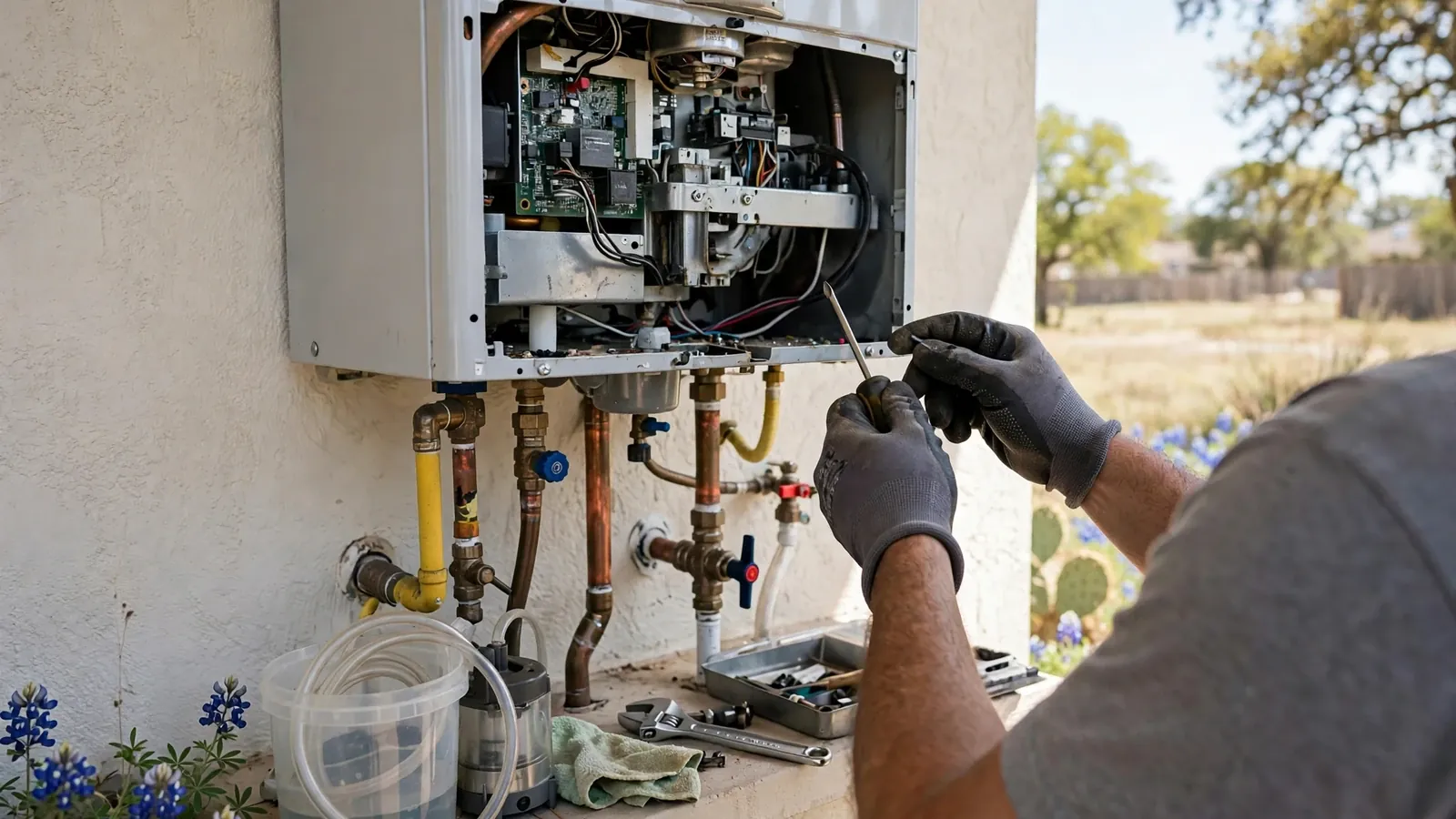
What size tankless water heater for a family of 6 in Palisades Park, NJ? Most large households land in the range of a high-output gas unit, rated around 9 to 11 gallons per minute (GPM) at a typical winter temperature rise, though the exact answer depends on how many fixtures run at once.
Tankless water heaters are sized by flow, not by tank gallons. Add up the fixtures that run together at your peak, work out how hot the water must be after the incoming water gets heated, and compare that to the maker's rating chart.
Step one: count your peak flow
Peak flow is the most hot water you will ask for at the same moment. In a house with six people, that is usually a weekday morning: two showers, a kitchen faucet, and a dishwasher or washing machine.
Most showerheads sold today use about 2.5 GPM or less, a kitchen faucet often uses 1.5 to 2.2 GPM, and a dishwasher or clothes washer draws a smaller amount of hot water. Check the label on your fixtures, since older ones can run higher.
Add them up. Two showers at 2.5 plus a kitchen faucet at 1.5 equals 6.5 GPM. If a third shower might run too, you are closer to 9 GPM. That number is what the heater has to keep up with.
Step two: find the temperature rise
Temperature rise is the gap between the incoming cold water and the hot water you want at the tap. If incoming water is near 45 F in winter and you want 120 F, the heater has to add 75 degrees.
A tankless unit gives its highest flow at a small rise and less at a big one. A model rated for 10 GPM at a 50 degree rise may only deliver about 6 or 7 GPM at 75 degrees. That is why the same heater can feel fine in July and weak in January.
Use the maker's flow-versus-rise chart with your winter number, not the headline rating on the box.
Not sure what you are looking at?
Call the 24/7 line and a dispatcher will help you decide what to do next.
Sizing options for a six-person home
These are general planning points, not a quote. A technician should confirm against the exact model.
| Peak use at home | Rough flow needed | What it usually points to |
|---|---|---|
| One shower plus one faucet | About 4 to 5 GPM | A mid-size gas unit or a large electric unit may keep up |
| Two showers plus kitchen | About 6 to 7 GPM | A high-output gas unit, checked at the winter rise |
| Three showers plus appliances | About 9 GPM and up | Top-end gas, or two units, with gas line and vent checked |
| Soaker tub fill while others shower | Varies by tub and fixtures | Check fill rate, may need larger unit or time-staggered use |
Two smaller heaters can also work for a big household. Each serves part of the house, and one can keep running if the other needs service.
Gas or electric for a large family
For six people, the fuel type often decides more than the brand.
Gas
Gas units can reach high flows, but need adequate gas supply, correct pipe size, and proper venting. Gas line and vent upgrades are common surprises.
Electric
Large electric models draw heavy current. Your electrical panel capacity and available breaker space can limit what fits.
Dual units
Splitting the load across two heaters can solve a flow or panel problem, at the cost of more equipment to maintain.
Existing tank
If your gas line or vent cannot handle a big tankless, a tank or a hybrid setup may be the more practical fit.
What to check before you buy
This short list keeps a purchase from turning into a repair call after the install.
- 1
Read your fixture labels
Note the GPM rating on each showerhead and faucet. Replace any that are unusually high flow.
- 2
Check the gas meter and line
Ask the installer to confirm the gas meter, regulator, and pipe run can supply a larger input rating.
- 3
Plan the vent path
The old tank flue is rarely right for a tankless. A new vent path may need new wall or roof work.
- 4
Ask about water treatment
In very hard water areas, plan for scale. A flush valve kit and a service plan help the heater last.
- 5
Confirm permit steps
Permit rules vary, so ask the Palisades Park Building Department before work starts.
When tank storage is the better call
Tankless is not always the best fit for a family of six. If you cannot bring a large enough gas line or vent to the unit, or the panel cannot carry an electric model, a tank may be simpler and cheaper to keep running.
Our dispatch can connect you with a licensed plumber for water heater installation who will look at the actual house before recommending anything. Call the 24/7 line and describe the layout.
Local water and permit notes for Palisades Park
Veolia's 2025 report for the Hackensack system shows a highest detected hardness of 210 ppm, which counts as very hard. Hardness is what builds scale inside a tankless heat exchanger, so a six-person household running the unit hard should plan on regular descaling.
The Palisades Park Building Department says plumbing permit fees are based on the number of fixtures and appliances, and plumbing inspections run Tuesday and Thursday mornings. Ask whether the new heater needs a permit and plan the install around inspection days. Households in Fort Lee and Leonia draw from the same Veolia system, so the same hardness advice applies there.
Common Questions
Most six-person homes need about 7 to 10 GPM at peak, depending on how many showers run together. Count your busiest morning, then check the heater's chart at your winter temperature rise.
Sometimes, if it is a high-output gas model and the winter temperature rise is modest. Many units cannot, and fixtures lose pressure or run cold. A second unit or a lower-flow showerhead can help.
Not the sizing, but it changes the upkeep. Scale narrows the heat exchanger over time and cuts the flow you actually get. Descaling on schedule keeps the rated capacity closer to what you paid for.
It may, but the venting, gas line, and condensate drain usually change. Wall-hung units free floor space, though a new vent path is required. A plumber should measure on site.
It depends on the building. Some towers limit gas appliances, venting, or electrical load, and the association may require approval. Ask building management first, then have a licensed plumber confirm.
Simple swaps can be done in a day, while gas line, vent, or electrical upgrades take longer. A technician can give you a realistic schedule after seeing the space.
Licensing and permits
Under New Jersey plumbing licensing standards, plumbing work is limited to licensed master plumbers, authorized plumbing contractors and their employees. You can check any plumber through the NJ Division of Consumer Affairs, State Board of Examiners of Master Plumbers. Palisades Park also publishes permit and inspection details on the borough website.